

Ever tried uploading a photo to a website, job portal, or government form and got rejected because the file was "too small"? Some platforms set a minimum file size in KB, and a tiny, heavily compressed image just won't pass. Increasing image size in KB means making the file take up more storage space. Perhaps you only need a heavier file that looks the same, but sometimes you also want higher resolution so the picture stays sharp when printed or viewed on a big screen. This guide covers both approaches, shows you free tools that work on desktop, mobile, and in the browser, and explains which method fits your situation.
Two Ways to Increase Image Size in KB
There are two common ways to boost an image's file size in KB. They solve different problems, so it helps to know the difference before you pick a tool.
Method 1: Direct file-size increase (same pixels)
In this way, you keep the same width, height, and visual look. The tool just stores the image with less compression, adds padding, or switches to a less-compressed format, and the image still looks the same. This is the right choice when a form or website only cares about the KB number and doesn't ask for higher resolution.
Method 2: Upscale/raise resolution
By upscaling, you increase the number of pixels. The file almost always becomes larger in KB because there is more data. If you use an AI upscaler, it not only enlarges the dimensions but also tries to keep or improve sharpness. Use this when you need the image to look good at larger print sizes or on high-resolution screens, or when the platform requires both a minimum KB size and higher pixel dimensions.
In short: if the only requirement is "file must be at least X KB", Method 1 is faster and safer for quality. If you also need a bigger or sharper picture, go with Method 2.
Method 1. How to Directly Increase File Size in KB
1. Pi7 Image Tool
Pi7 Image Tool is a free online service that lets you type the exact KB size you need. You only need to upload a photo, enter a target like 100 KB or 200 KB, and it raises the file size to that target while keeping the original pixel dimensions. It works on any device with a modern browser, and supports JPG, JPEG, PNG, and several other common image types.
Step 1Open the tool
Go to the Pi7 Image Tool website in your browser. Search for the tool named Increase Image Size in KB.
Step 2Upload your image
Click Select Image or drag and drop the file.
Step 3Enter the target size
In the Required Size input box, type the KB value you need.
Step 4Process and download
Click Increase Size. When the process finishes, download the new file and check its size.

- It is easy for anyone to navigate and use.
- It supports various image formats for convenience.
- Lets you set an exact target KB size.
- Keeps original pixel dimensions.
- Processing larger files could take time.
- It requires an internet connection for operation.
- The downloading process contains advertisements.
2. ImResizer
ImResizer is another free browser-based tool that can raise image file size to a target KB or MB value. Everything runs locally in the browser, so your photo stays on your device. It accepts images in JPG, JPEG, PNG, and WebP. You can choose to keep the original dimensions or let the tool scale it for the target size.
Step 1Step 1. Visit ImResizer
Open imresizer.com in your browser.
Step 2Step 2. Set the target
Type the desired file size in KB or MB. If you want the photo in an exact width and height, choose the Fixed Size mode and type the dimensions you want. If it's okay for the tool to scale your image, select Auto or Scale.
Step 3Step 3. Start Resizing
Choose your preferred format from JPG, JPEG, PNG, PDF, and WebP. Then upload your photo to the workspace. Let the tool process the file, then download the result. Check the new size on your device.

- Browser-based and private.
- Supports exact KB/MB targets.
- Finishes the process in seconds.
- Results can vary slightly from the exact target.
- Limited editing options
Method 2. How to Increase File Size in KB by Raising Resolution
1. AVAide Image Upscaler
Do you have small images that you wish were bigger and clearer? Meet AVAide Image Upscaler, your go-to platform to help you increase image size in KB. Because it adds more pixels and applies AI enhancement, the output file is almost always larger in KB while staying sharp. That makes it useful both for a larger file and for better visual quality. You can upscale photos in common formats like JPG, JPEG, PNG, and BMP. With a paid plan, it also supports batch upscaling, which saves your time when you need to enlarge multiple files.
Step 1Step 1. Open AVAide Image Upscaler
Visit the official AVAide Image Upscaler page in your browser.
Step 2Step 2. Upload your photo
Click Add Your Image or use the batch upload option (paid) if you have several images.
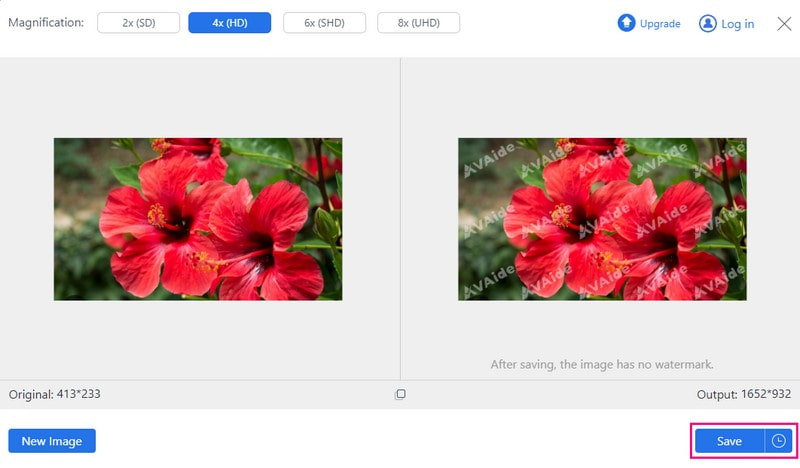
Step 3Step 3. Choose magnification
Select an enlargement target. After 2× upscaling, the file size usually becomes 3 – 4 times the original. Then the AI processes the image and shows a preview.
Step 4Step 4. Download
If the preview looks good, click Save. The enlarged image downloads with a higher file size and improved clarity.
- It does not embed a watermark on the output image.
- The user's information is safe and will not be accessed or used.
- It is accessible to any web browser and does not require any payment.
- It uses top-notch artificial intelligence and enhances the image automatically.
- The upload photo in batches feature requires users to update their plans.
2. GIMP
GIMP is a powerful and free image-editing platform that helps you with many tasks with your images. These are adding effects, changing colors, making drawings, and increasing image size. It offers options to change the size and quality of your image. With that, you can get a bigger image and, at the same time, high quality.
Step 1Step 1. Open the image
Launch GIMP and open the photo you want to enlarge.
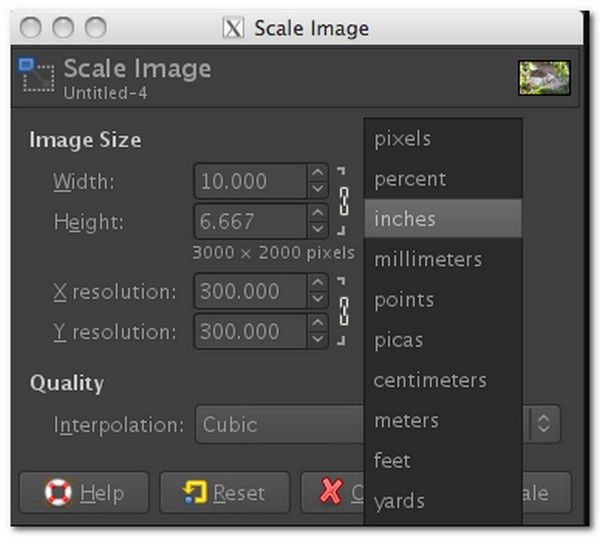
Step 2Step 2. Scale the image
Click on Image in the top menu. Then, choose Scale Image from the drop-down menu. Enter new dimensions or a percentage. Keep the aspect-ratio lock on.
Step 3Step 3. Export at high quality
Go to File, Export As, and choose JPEG or PNG format. Modify the quality slider to increase file size while preserving quality. Save the image and check the new KB size.
3. Photo Resizer HD
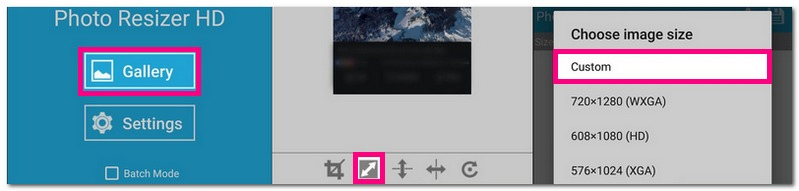
Photo Resizer HD is a simple and easy-to-use mobile application that can help you increase the size of the image in KB. The best part? It can sharpen your photos, even after resizing and increasing the image size. Besides that, it offers options to crop, rotate, and horizontally and vertically flip. With this application, you can save your output on your phone and other supported applications.
Step 1Install Photo Resize HD on your mobile device. Once installed, open it.
Step 2Tap Gallery to select the photo you want to increase the size.
Step 3Tap the Diagonal Arrow button, then select Custom. Then, enter the new size numbers in the provided text fields. Ensure that Keep aspect ratio is checked to maintain proportions.
Step 4Tap the OK button to apply the changes. Finally, save the output using the Floppy Disk button in the top-right corner.
- It offers various preset image sizes.
- It maintains proportions for better quality.
- It enables users to input their preferred size.
- It is only accessible on Android devices.
- The free version comes with an advertisement.
- It does not cost anything.
- It works on different operating systems.
- It offers a range of editing features beyond resizing.
- The interface can be overwhelming for beginners.
- It can be slower with large files or complex tasks.
FAQs about Increasing Image Size in KB
How many KB should an image be?
It depends on the use case. For web pages, many sites aim for 50–200 KB per image to keep loading fast. For print or high-quality display, files of several hundred KB to a few MB are common. Always check the specific requirements of the platform you are uploading to.
Does increasing image size reduce quality?
Not necessarily. If you only raise the file size by lowering compression or adding padding while keeping the same pixels, the picture looks the same. If you stretch the image to more pixels without good upscaling, quality can drop. AI upscalers like AVAide Image Upscaler are designed to enlarge images without losing quality.
What size should an image be in KB for a website?
Most modern websites prefer images under 200-300 KB for good performance, but some forms or portals also set a minimum. Check the upload rules of the specific site. If the site only lists a maximum, you don't need to increase the size.
How do I check an image's size in KB on the computer?
On Windows, right-click the file, choose Properties, and look at the Size field. On Mac, right-click or Control-click and choose Get Info. On mobile, open the file details in your gallery or file manager.
When should I use KB or MB to measure file sizes?
KB (kilobytes) is common for smaller images and documents. Once a file passes roughly 1,000 KB it is usually described in MB (megabytes). High-resolution photos, short videos, and large graphics are typically measured in MB.
That is where how to increase image size in the KB online, offline, and mobile journey ends! They are just easy to follow, right? Among the tools, we recommend ImResizer for an exact target KB, or AVAide Image Upscaler for a larger and clearer photo.
ABOUT THE AUTHOR


Our AI technology will automatically enhance the quality of your images, remove noise and fix blurry images online.
PROCESS NOW